What is the point of doing experiments?
3 Feb, 2026 at 21:14 | Posted in Theory of Science & Methodology | 1 Comment
Why bother with the theories? Because science seeks to understand the world and to explain the experimental facts, and you need theories to do that. Theories are not just heuristic aids, “useful instruments that aid the growth of experimental knowledge,” as Chalmers accuses Mayo of thinking … What is the point of doing experiments? It is not just to accumulate reliable experimental knowledge. That is important, to be sure, but we seek reliable experimental knowledge to adjudicate between rival explanatory theories about the way the world is.
Alan Musgrave
Alan Musgrave’s response to Deborah Mayo’s claim that empirical testing does not tell us whether a theory is true strikes at the very heart of his critical rationalism. Mayo maintains that empirical tests can only show whether a hypothesis has passed or failed ‘severe tests’. For her, science is fundamentally about error detection, not truth confirmation.
But although empirical testing never yields certainty, this does not mean testing is epistemically neutral with respect to truth. The very point of ‘severe tests’ is that passing them gives us good reason to believe a theory is true. If empirical success does not count as evidence for truth, then it is unclear why science should be taken seriously at all.
As scientists, we do not merely aim to avoid error — we also seek to discover how the world actually is. That a theory has passed “severe tests” which other theories have not offers no absolute guarantee of its truth. But arguably, it does furnish a warrant for believing it to be so.
Conversations in Real-World Economics
3 Feb, 2026 at 15:15 | Posted in Economics | Leave a comment
Jamie: Lars, perhaps a useful place to start would be with some introductory comment on what informs your reasoning. Whilst your postings range across many subjects you regularly return to a common theme. Specifically, the use economists make of mathematics to express theory and of analytical statistical techniques to conduct research. What are the key problems you see here and in what sense can or should matters of methodology provide a common thread to this common theme?
Lars: Well, I think the main problem here when it comes to applying mathematics and inferential statistics to economics is that mainstream economists usually do not start by asking themselves if the ontology — real-world economies and societies — is constituted in a way that makes it possible to explain, understand or forecast our economies and societies with the kind of models and theories that mathematics and inferential statistics supply.
The basic fault with modern mainstream economics, in my view, is that the concepts and models it uses — often borrowed from mathematics, physics, and statistics — are incompatible with the very objects of economic study. The analytical instruments borrowed from the natural sciences and mathematics were constructed and used for totally different issues and problems. This has fundamentally contributed to the non-correspondence between the structure of economic science and the structure of real-world economies. And I think it may also be one of the main reasons why economists so often have come up with doubtful — and sometimes harmful — oversimplifications and generalizations.
Using simplifying tractability assumptions — rational expectations, common knowledge, linearity, ergodicity, etc. — because otherwise one cannot “manipulate” the models or come up with rigorous and precise predictions and explanations, does not really exempt economists from having to justify their modelling choices. Being able to manipulate things in models cannot be enough to warrant a methodological choice.
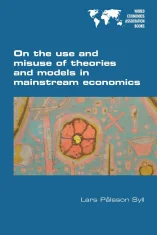
Take, for example, the discussion on rational expectations as a modelling assumption. Those who want to build macroeconomics on microfoundations usually maintain that the only robust policies are those based on rational expectations and representative actor models. As I tried to show in my book On the use and misuse of theories and models in mainstream economics (2016) there is really no support for this conviction at all. If microfounded macroeconomics has nothing to say about the real world and the economic problems out there, why should we care about it? The final court of appeal for economic models should not be if we — once the tractability assumptions are made — can manipulate them. As long as no convincing justification is put forward for how the inferential bridging is made, mainstream model building is little more than hand-waving.
Liberalernas supersänke — Romina Pourmokhtari
2 Feb, 2026 at 21:14 | Posted in Politics & Society | 3 Comments
Det här förvånar kanske först, men när man väl erinrar sig att den nämnda klimatministern är Romina Pourmokhtari faller allt på plats. En större klimatkrisförnekande svammelminister — som år efter år vägrat svara på alla berättigade frågor som ställs om frånvaron av en seriös klimatpolitik — har vi nog aldrig haft i vårt land.
Med en sådan klimatminister är det föga förvånande att förtroendet för Liberalerna har nått ett bottenrekord och att partiet ä på väg ut ur riksdagen.
Välförtjänt!
Oxfam report on growing inequality in Sweden
1 Feb, 2026 at 10:33 | Posted in Economics, Politics & Society | 1 Comment The 2026 Oxfam report, Our Unequal Sweden, issues a damning indictment of the nation’s economic trajectory, systematically dismantling the enduring myth of Swedish egalitarianism. It reveals a society undergoing a profound and deliberate schism, where escalating mass vulnerability exists in parallel with unprecedented wealth consolidation among a tiny elite.
The empirical evidence is overwhelming and alarming. A surge of 120,000 individuals into poverty within a single year expands the impoverished population to approximately 700,000. Concurrently, over a quarter of households report being unable to afford essential goods, while energy poverty — measured by the inability to heat one’s home — tripled between 2021 and 2023. This tangible deprivation contrasts violently with the fortunes of the apex: the combined wealth of Sweden’s 46 billionaires, which surpasses the assets of the poorest 80% (8 million people), grew by an estimated 24% in one year alone.
Sweden ranks (according to last year’s the UBS Global Wealth Report) as the sixth most unequal country in the world in terms of wealth distribution. This places Sweden ahead of many countries commonly associated with extreme inequality and, strikingly, more unequal than the United States, which ranks seventh in the same index. The comparison underscores the severity of wealth concentration in Sweden and challenges the widespread perception of the country as an economic outlier defined by equality. In fact, Sweden is among the most wealth-unequal societies globally.
Critically, the Oxfam report frames this widening income- and wealth-gap not as a natural economic phenomenon but as the direct consequence of deliberate fiscal policy. Decades of regressive tax reforms — systematically reducing burdens on capital, inheritance, and wealth while increasing reliance on consumption taxes — have actively engineered one of the world’s highest levels of wealth inequality.
Oxfam rightly contends that such extreme economic concentration poses an existential threat that extends beyond questions of social justice; it corrodes the foundational principles of democracy. Disproportionate wealth translates into disproportionate political influence, eroding institutional trust and undermining the principle of equal citizenship. The report thus calls not for minor adjustments but for a major policy shift: the establishment of a comprehensive wealth register, radical transparency in lobbying, and aggressively progressive taxation. It concludes that the celebrated Swedish model is not self-sustaining and requires urgent, deliberate intervention to prevent the irreversible unravelling of its social contract.


-


Recent Comments
Reading List


Blog at WordPress.com.
Entries and Comments feeds.
 LARS P. SYLL